This guide contains affiliate links. If you book through them I may earn a small commission at no extra cost to you. I only recommend things I have used myself.
Three days is the right amount of time for a first trip to Kuala Lumpur. It’s enough to see the old city, the Petronas Towers and Batu Caves without rushing, and to spend your evenings on rooftops. Add a fourth day if you want a proper day trip, whether that’s Malacca’s old town, the hill temples at Genting or the fireflies at Kuala Selangor.
This Kuala Lumpur itinerary follows what I did in June, with the practical bits I’d want to know before going back: which area to stay in, how to get around, the best time to visit and the day trips worth your time. If you only want the highlights, my 6 things to do in Kuala Lumpur is the short version.

Before you go
UK passport holders can visit Malaysia for up to 90 days without a visa. You do need to fill in the Malaysia Digital Arrival Card (MDAC) online within the three days before you arrive, and the day you submit counts as one of them. Have your passport details, your flight details and the address where you’re staying ready.
The MDAC is free. Submit it on the official MDAC portal (there’s more on the Immigration Department of Malaysia’s MDAC page) and ignore the third-party sites that charge a fee for it.
The currency is the Malaysian ringgit (RM). Cards are taken almost everywhere in the city, but keep some cash for food stalls and markets. Malaysia is a majority-Muslim country, so cover your shoulders and knees at temples and mosques. Most of the big ones lend robes or sarongs at the door.
3 days in Kuala Lumpur: my itinerary
01
Day 1: Chinatown, old KL and the towers at night
Start in Chinatown early, before the heat and the crowds. I was walking through Kwai Chai Hong, the little back lane of murals off Petaling Street, by nine in the morning and had it almost to myself. Petaling Street’s market is quieter in the morning and busier from late afternoon.
From there it’s a short walk to Merdeka Square, where the Union Jack was lowered at midnight on 31 August 1957, and the Moorish-style Sultan Abdul Samad Building that faces it. Carry on to Masjid Jamek, the mosque where the Klang and Gombak rivers meet. This stretch is the River of Life, and it’s lit up blue after dark if you come back later.
Spend the afternoon somewhere cool (Suria KLCC under the Petronas Towers is the obvious choice), then walk out into KLCC Park as the light fades. The towers switch on at dusk and the lake in front of the mall has evening fountain shows. Finish with dinner on Jalan Alor, Bukit Bintang’s food street.


02
Day 2: Batu Caves, the palace and Thean Hou Temple
This is the day I’d copy exactly, because it’s how I did it. Get to Batu Caves as early as you can and climb the 272 rainbow steps to the Temple Cave before it gets hot. There’s more on the caves in the day trips section below.
Head back into the city around midday and stop at Istana Negara, the king’s official residence. You can’t go in, but the golden domes and the mounted guards at the main gate are worth ten minutes. Then rest through the hottest part of the afternoon and take a Grab to Thean Hou Temple for dusk, when the lanterns come on over the courtyard. I’d already seen it on a tour but went back by Grab at dusk for better photos, and it was worth the second trip. End the day at a rooftop bar or pool facing the Petronas Towers.


03
Day 3: The skyline from above, then Bukit Bintang
Use the morning to get high. The Petronas Towers tour takes you across the Skybridge on levels 41 and 42, 170 metres up, and on to the observation deck on level 86. It’s open 9am to 9pm and closed on Mondays, and timed slots sell out, so book online a few days ahead.
KL Tower is the alternative, and it gives you a view of the Petronas Towers rather than from them. Non-Malaysian tickets are RM55 for the indoor deck at 276 metres or RM80 for the open-air Sky Deck at the top. Merdeka 118, the second-tallest building in the world, is building its own observation deck, so check whether it’s open when you visit.
In the afternoon, walk the covered, air-conditioned walkway from KLCC to Bukit Bintang and spend a few hours in the malls and side streets there. Keep your last evening free for sunset at a rooftop bar.
If the afternoon heat gets too much, Immersify KL at Bukit Bintang City Centre is a good escape. It’s a huge indoor digital art gallery, around 30,000 square feet of projection rooms and interactive installations, a three-minute walk from Hang Tuah station. I went and thought it was good. Allow 60 to 90 minutes.
Jay’s tip
Plan the outdoor sights for the morning and late afternoon. KL is hot all day and the afternoons often bring a heavy downpour, so the middle of the day is the time for a mall, a long lunch or the hotel pool.
Short on time, or would rather someone else handled the logistics? I used this full-day guided tour of Kuala Lumpur, which fits around 25 sights into about ten hours, including Batu Caves, Istana Negara and Merdeka Square, with hotel pickup as an option. I’d been to KL before, so I did about six hours of it, mainly for the caves and a temple I hadn’t seen, and skipped the stops I already knew, like shopping at the Petronas Towers. It’s a good way to see a lot quickly on a first visit.
Day trips from Kuala Lumpur
KL makes an easy base for day trips. Batu Caves is close enough for half a morning, and Malacca, Genting, Putrajaya and Kuala Selangor each fill a full day.
Batu Caves: which caves to see
Batu Caves is a Hindu temple complex inside a limestone hill about 13 km north of the centre, and it’s the one trip out of the city everyone should make. The 42.7-metre golden statue of Lord Murugan stands at the foot of the 272 painted steps, and the steps lead up to the main Temple Cave, a huge cavern with shrines and an opening to the sky.

There’s more to the site than the main cave:
- Temple Cave: free, open from about 6am to 9pm. This is the one at the top of the rainbow steps.
- Ramayana Cave: RM5, 9am to 6pm. A smaller cave to the left of the main square, lit in bright colours and lined with scenes from the Ramayana.
- Cave Villa: RM15 for non-Malaysians, 8.30am to 5.30pm. Painted caves, a koi pond and Hindu art at the bottom of the hill.
- Dark Cave: guided tours into an undeveloped cave system from RM35. It has closed for long spells in the past, so check it’s running before you plan around it.
The KTM Komuter train from KL Sentral runs to Batu Caves, the last stop on the line, for around RM2.60, and the entrance is right by the station. A Grab is quicker if you’re going first thing. Cover your shoulders and knees (sarongs are available at the bottom of the steps) and keep food out of sight, because the monkeys on the steps will take it.
Jay’s tip
Go early. I was on the steps before 10am and it was already warm, and the crowds and tour buses build through the morning.
Genting Highlands and Chin Swee Caves Temple
Genting is a hill resort about 58 km from KL and roughly 1,800 metres up, so it’s noticeably cooler than the city. Most people go for the casino and theme park, but the better reason is Chin Swee Caves Temple, a Taoist temple built into the hillside with a nine-storey pagoda and a 15-metre Buddha statue.
Buses run from KL Sentral, Pudu Sentral, TBS and Titiwangsa to Awana, where you pick up the Awana SkyWay cable car. It stops at Chin Swee Station on the way up, so you can visit the temple without paying extra. Allow 1.5 to 2 hours each way, and check the SkyWay isn’t closed for maintenance before you set off.
Malacca
Malacca’s old town is a UNESCO World Heritage Site with Portuguese, Dutch and British history packed into a few walkable streets: the red Dutch Square and Stadthuys, St Paul’s Hill, the ruins of A Famosa and the shophouses of Jonker Street.
Buses leave TBS (Terminal Bersepadu Selatan) throughout the day for Melaka Sentral, taking around two to two and a half hours for roughly RM10 to RM18. From there it’s a short Grab into the old town. Leave by 8am to make a day of it. The Jonker Walk night market only runs on Friday, Saturday and Sunday evenings, so if you want to see it, stay the night rather than rushing for a late bus.
Putrajaya and the pink mosque
Putrajaya is Malaysia’s purpose-built government city, and its Putra Mosque, built from rose-pink granite on the edge of a lake, is the reason to go. Take the KLIA Transit (not the KLIA Ekspres, which doesn’t stop) from KL Sentral to Putrajaya & Cyberjaya, about 20 minutes, then a short Grab to the mosque.
Entry is free and non-Muslims can visit outside prayer times, usually 9am to 12.30pm, 2pm to 4pm and 5.30pm to 6pm, with Friday visits only in the afternoon. Robes are provided at the entrance. Late afternoon is the best time for photos, when the pink stone warms up.
Kuala Selangor: fireflies and Sky Mirror
About an hour’s drive north-west of KL, the mangroves along the Selangor River are home to one of the largest firefly colonies in the world. Small boats go out from Kampung Kuantan after dark, and just after 8pm on a clear, moonless night is the best time to see them. The last public bus back leaves Kuala Selangor around 7pm, so this one is easier as a tour or with a Grab both ways.
Sky Mirror is the other draw: a sandbar off the coast that turns into a giant reflecting pool at low tide. It only works for a few days around the lowest tides each month, with boats leaving in the morning, so book a tour that runs on the right dates.
Side trips from Kuala Lumpur: Penang and Langkawi
With more time, KL pairs well with a few nights on Malaysia’s west coast. Both islands are about an hour’s flight away, and January and February are usually the best months for them.
Penang
George Town, Penang’s old capital, shares Malacca’s UNESCO listing and is known as the country’s food capital. Spend your days on the street art and shophouses of the old town, the clan houses and the views from Penang Hill, and your evenings at the hawker stalls. Two or three nights is about right.
Flying takes about an hour. The ETS train from KL Sentral to Butterworth is the more relaxed option at around 3.5 to 4.5 hours, depending on the service. It stops on the mainland, so finish with the passenger ferry across to George Town, which runs every 20 to 30 minutes and takes about 20 minutes.
Langkawi
Langkawi is the beach option: an archipelago of 99 islands off the north-west coast, with rainforest, island-hopping boat trips and long sandy beaches around Pantai Cenang. The SkyCab cable car up Gunung Mat Cincang and the curved Sky Bridge at the top are the big sights, and the island is duty-free.
Flights from KL take just over an hour and are the obvious choice. Overland, take the ETS train to Arau, then a short ride to Kuala Perlis for the ferry, which takes about 1 hour 15 minutes. To do both islands, fly between them or go via Kuala Perlis, because the direct Penang to Langkawi ferry hasn’t run since the pandemic.
Where to stay in Kuala Lumpur
KL is spread out, so the area you pick shapes the trip. For a first visit, I’d stay in KLCC or Bukit Bintang.
- KLCC: best for first-timers. You’re beside the Petronas Towers and KLCC Park, with the best skyline views and the most hotels with rooftop pools. It costs more and is quieter at night.
- Bukit Bintang: best for food, shopping and nightlife, with Jalan Alor and the big malls on the doorstep. It’s busy and noisy, which is the point.
- Chinatown: best on a budget. Cheaper rooms, heritage streets and street food, and close to Merdeka Square and the rivers.
- Bangsar: a quieter, leafier area with good restaurants and bars. Better for a longer stay or a second visit.
- KL Sentral: the transport hub, handy if you have an early train to the airport or a lot of day trips planned.
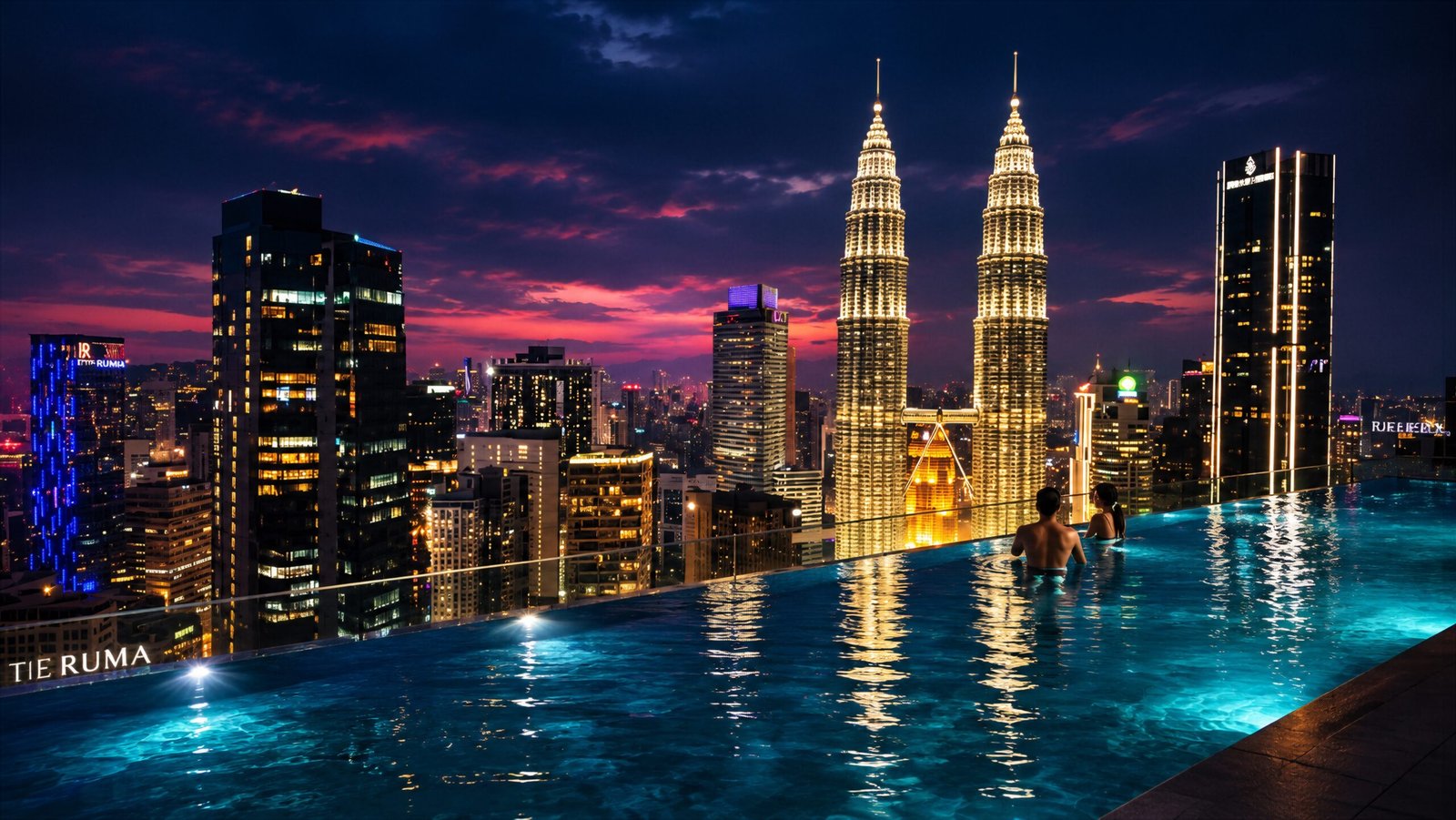
Whichever area you choose, it’s worth paying a little more for a rooftop pool that faces the towers. KL has more of them than anywhere I’ve been, and they cost far less than they would in Singapore or Dubai. These are the two I stayed in on this trip, and I’d happily recommend both.

Best for a rooftop infinity pool
The Platinum Suites
The Platinum Suites is a complex of three towers: The Face Suites, Platinum and Platinum 2. They’re advertised together as The Face Suites and Platinum, which sounds confusing, but it isn’t once you’re there: if you want DEEPBLUE, just ask at reception for directions. I stayed at The Face Suites on an earlier trip, when the newer towers were still being built. This time I stayed in Platinum 2, mainly for its much larger L-shaped infinity pool on the roof.
From my hotel I could look straight across at the rooftop pool on the Platinum tower, with DEEPBLUE, a sky restaurant and bar, right beside it. I walked across one evening for dinner with the Petronas Towers lit up across the skyline. The rooms are large and the facilities are good, including a gym. The complex is on Jalan Sultan Ismail in the Golden Triangle, a short walk from KLCC Park.
It’s a popular hotel, though, so the check-in can be a bit tedious.

Best for a private pool
Imperial Lexis Kuala Lumpur
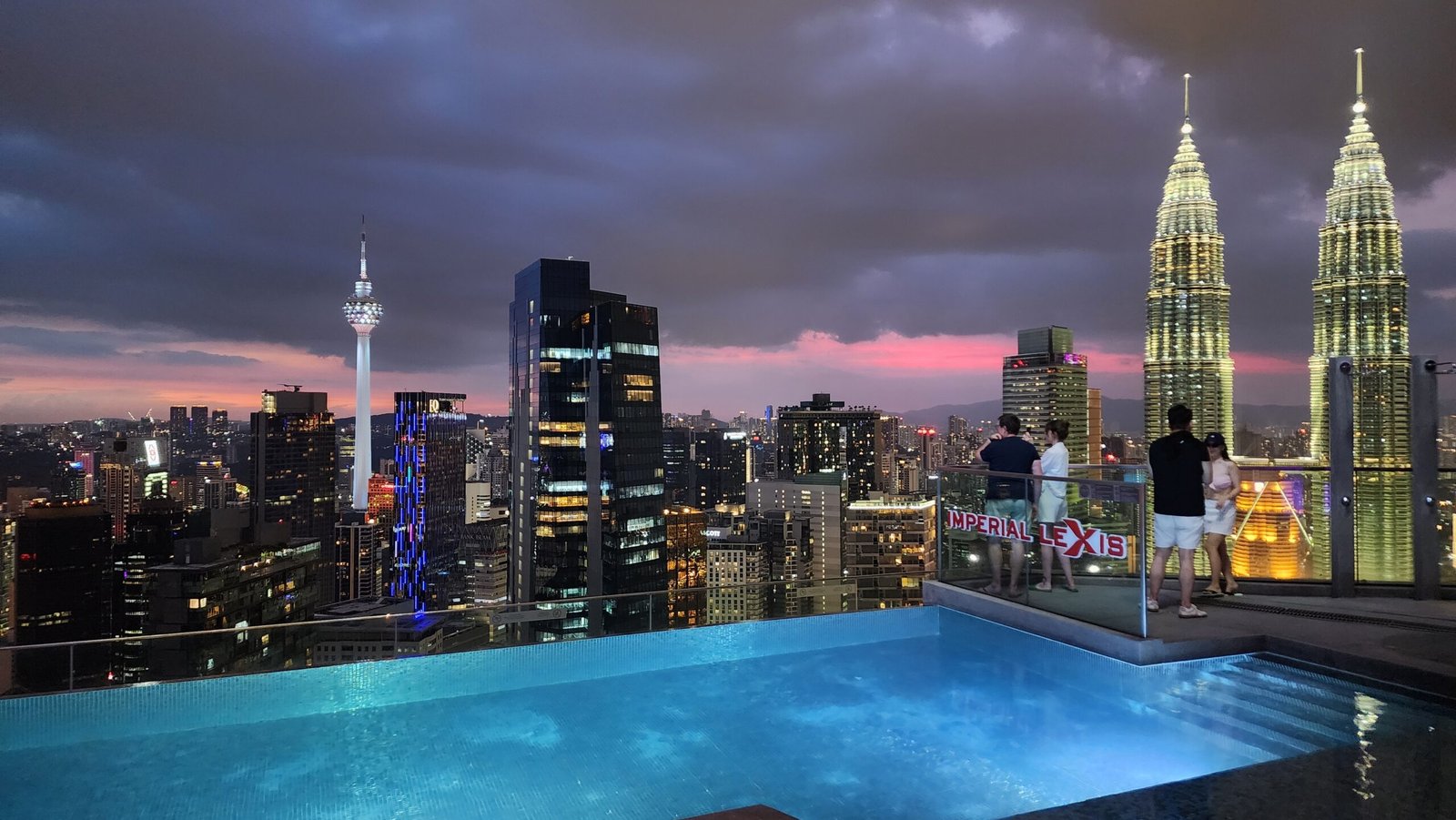
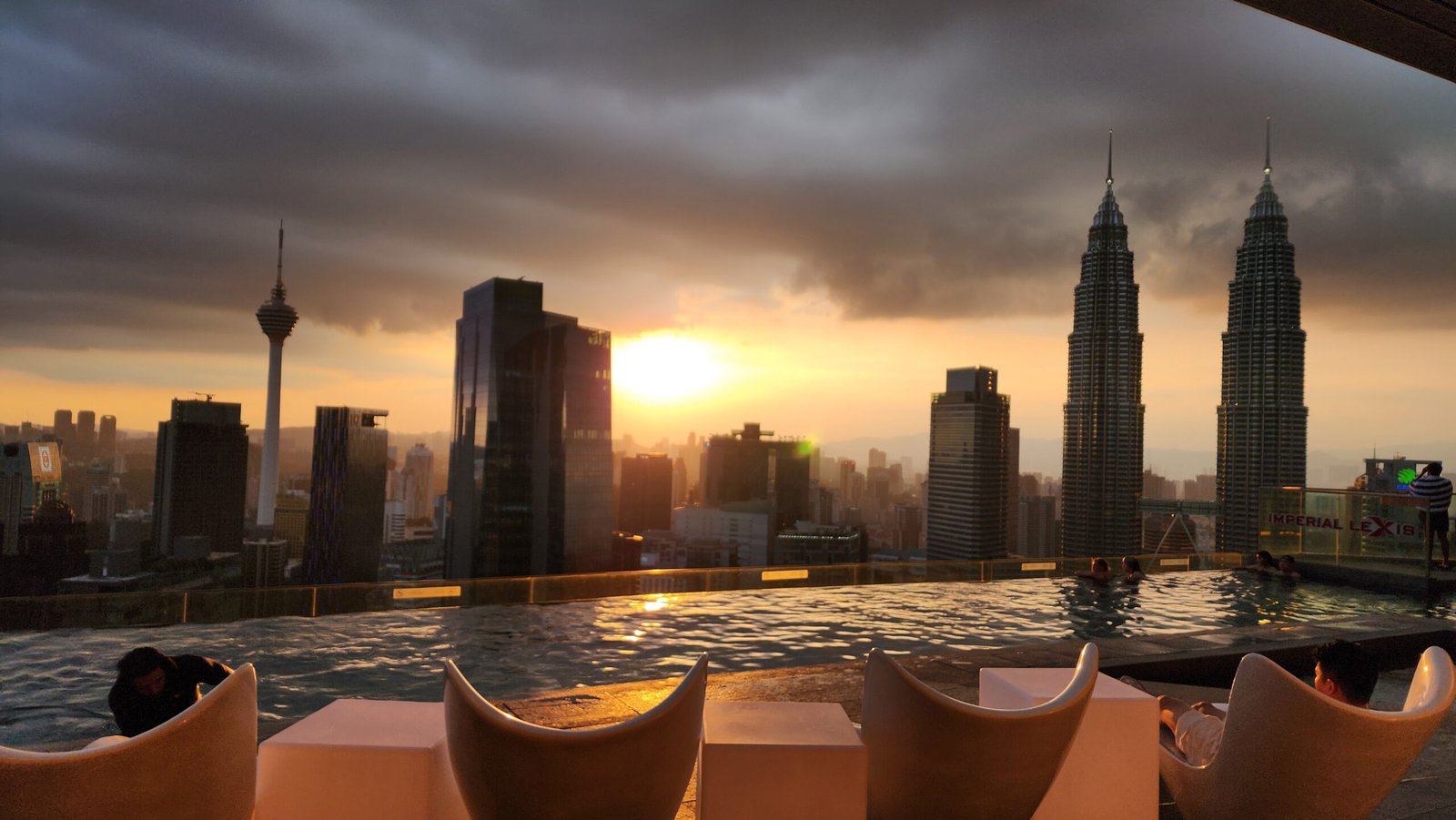
I stayed here in June 2026, and the big draw is the private pool: your own swimming pool, right there in your hotel room. You don’t come across that every day, especially in the middle of a city. I had one of these rooms and thought it was fantastic. Coming back to your own pool after a day exploring KL makes the stay feel that little bit more special.
The rooftop is the other reason to stay. The pool, bar and restaurant up there have some of the best views I’ve seen in Kuala Lumpur, and for me they were one of the highlights of the trip.
It’s at 15 Jalan Kia Peng, close to KLCC, so it’s a convenient base for the centre. Would I stay again? Absolutely. If you want something more memorable than a standard city hotel, the private pool sets it apart and the rooftop views complete it.

Getting around Kuala Lumpur
From the airport, the KLIA Ekspres train runs non-stop to KL Sentral in 28 minutes. A single is RM55, rising to RM65 from 1 January 2027. With heavy bags or a late arrival, a Grab is easy and reasonably priced.
In the city, the LRT, MRT and monorail reach most of the sights in this itinerary. Buy a Touch ‘n Go card (about RM10 at stations and 7-Eleven) and top it up, or tap a contactless bank card at the gates. The GoKL city buses loop around KLCC, Bukit Bintang and Chinatown; they’re free for Malaysians and RM1 a ride for visitors. For everything else I used Grab, one of the travel apps I use on every trip. Trains beat cars in the evening, when the traffic builds.
Where to eat, drink and go out
KL’s food mixes Malay, Chinese and Indian cooking, often on the same street. Jalan Alor in Bukit Bintang is the famous night food street, lined with stalls and open-air tables from early evening. Chinatown is better for a cheaper, more local feel, and Nasi Ayam Hainan Chee Meng, a Michelin Bib Gourmand pick, is the place for Hainanese chicken rice.

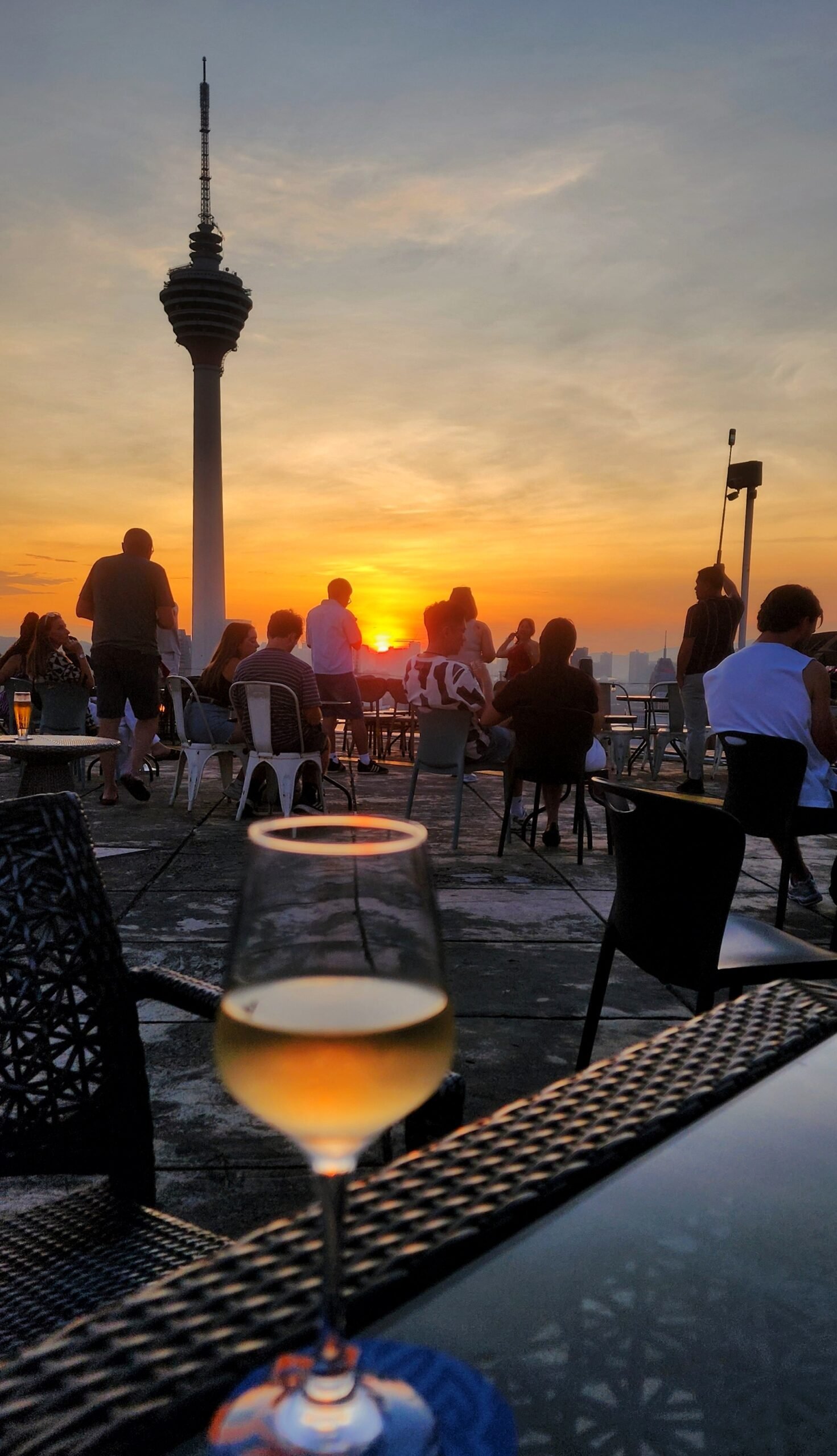
For drinks with a view, my pick is Heli Lounge Bar on Jalan Sultan Ismail. It’s a working helipad by day and an open-air bar at night, with nothing between you and the skyline, and I watched the sun go down behind KL Tower from up there with a glass of wine. Arrive before sunset to get a table.
For a big night with the towers as the backdrop, go to WET Deck, the pool bar on the 12th floor of the W Kuala Lumpur. It was one of my favourite nights in the city. Arrive early for snacks and the sunset, then stay for the DJ, who gets going at around 10pm. There’s more on it in my 6 things to do in Kuala Lumpur.
Two more worth knowing: Marini’s on 57, on level 57 of Petronas Tower 3, close enough to the twin towers to feel you could touch them, and SkyBar at Traders Hotel, which looks straight across KLCC Park to the towers. Opening hours change, so check before you go. Alcohol is taxed heavily in Malaysia, which means drinks often cost more than dinner.
After the rooftops, head to Bukit Bintang. Together with Changkat Bukit Bintang, it’s the heart of the city’s party scene, and it’s where I’d go for a night out. Changkat is basically one long strip of pubs and bars under neon signs, most of them open to the street, and it gets extremely crowded from about 7pm. It’s a short walk from Jalan Alor, so you can eat at the stalls first and walk round the corner for drinks.
Chinatown has an edgier feel. Around Petaling Street and Jalan Panggung, the bars hide behind unmarked doors and old shopfronts. The best known is PS150, tucked behind what looks like a vintage toy shop at 150 Jalan Petaling.
For proper clubbing, go to TREC on Jalan Tun Razak, a purpose-built nightlife hub with a strip of bars and clubs called Electric Boulevard. It’s the place for EDM, big DJ nights and upbeat music. The clubs don’t really get going until after 11pm, and door policies can be strict, so bring ID.
Best time to visit Kuala Lumpur
KL is hot and humid all year, with daytime temperatures usually around 30°C, so there’s no bad time to go. The driest stretch is roughly June to August, with January and February also good. October, November and April tend to be the wettest months. Even then, rain usually comes as a heavy afternoon storm that clears within an hour or two. I went in June and planned the outdoor sights for the mornings, which worked well.
Kuala Lumpur FAQs
Is 3 days enough in Kuala Lumpur?
Yes, for the main sights. Three days covers Chinatown and old KL, the Petronas Towers, Batu Caves and Thean Hou Temple. Add a fourth day for Malacca, Genting or the fireflies.
How do I get to Batu Caves from Kuala Lumpur?
Take the KTM Komuter train from KL Sentral to Batu Caves, the last stop, for about RM2.60, or take a Grab. The Temple Cave is free.
Do I need a visa for Malaysia?
UK citizens can stay up to 90 days without a visa, but almost every visitor must complete the free Malaysia Digital Arrival Card on the official MDAC portal within three days before arrival. You’ll need your passport, flight details and accommodation address.
What should I wear in Kuala Lumpur?
Light, breathable clothes and something for the rain. For temples and mosques, cover your shoulders and knees; a light scarf or sarong in your bag saves renting one.
Tours and tickets in Kuala Lumpur
Carrying on around Asia? Bangkok is a short flight away, and my Le Du Kaan review is the dinner to book when you land. Bali is about three hours by air: here’s how to get from Bali to Gili Trawangan once you’re there.